AstroPreciseFree field edition · v1
Astronomy · fieldcraft · reflection
The Eclipse Field Guide
12 August 2026
One precise plan for the path, the London clock, eye safety, a clear western horizon and an honest record of what you actually observe.
Precision first.
Wonder without exaggeration.astroprecise.app/eclipse.html
Wonder without exaggeration.astroprecise.app/eclipse.html
Astronomy01 · The path
Five landfalls.
One brief totality.
On 12 August 2026, the Moon’s central shadow crossed northern Russia, Greenland, Iceland, Spain and a small part of Portugal.
At greatest eclipse, the central duration is about 2 minutes 18 seconds. NASA notes that most places in the path receive less than two minutes, and even the longest locations remain under two and a half minutes.
These are route-level facts, not a promise for every town within a named country. If you intend to travel, confirm your exact viewing point against an authoritative ground-track map and a checked local calculation.
This guide was written for the night; it remains the record. The short duration was not a reason to rush. It was a reason to prepare: know where you would stand, which clock you trusted and how you would protect your eyes before the event began.
A country name is not a local viewing guarantee.
Northern RussiaLandfall
GreenlandTotality
IcelandTotality
SpainTotality
PortugalSmall area
Greatest eclipse17:45:51 UTC
Central duration02m 18s
Central path width293.9 km
Sources checked 11 August 2026: NASA · Total Solar Eclipse on August 12, 2026 · NASA GSFC · Besselian Elements. The route list is not a ground-track map.
Astronomy · London02 · The field clock
Four times
to keep.
London sees a deep partial eclipse. The Sun remains low in the west, so your horizon matters as much as the timetable.
The plan for that night: be settled somewhere with a genuinely clear western view before first contact. If you wanted NASA’s coverage alongside your own observation, open it before 18:15—then put the screen down when the sky deserves your attention.
These times belong to London. Do not transfer them to another town or country without checking local circumstances.
London: partial · about 91% · low in the west · viewers stay on.
NASA’s city table gives 19:13; Royal Observatory Greenwich gives 19:12. This guide therefore prints “about 19:13” rather than pretending the one-minute rounding difference is precision. Sources: Royal Observatory Greenwich · NASA Live.
Astronomy · Safety03 · Protect the view
Eye safety is
part of the experience.
For London—and everywhere outside totality—there is no safe unfiltered moment. Use special-purpose solar viewers throughout every partial phase.
Use genuine eclipse glasses or a handheld solar viewer that conforms to the international standard. Ordinary sunglasses are not safe, however dark they appear.
Cameras, binoculars, telescopes and other optics need a suitable solar filter secured across the Sun-facing front aperture—not at the eyepiece.
Before looking up: inspect the viewer. Discard it if scratched, punctured, torn or otherwise damaged. Supervise children. Put the viewer in place before turning toward the Sun; turn away before removing it.
If you cannot confirm that a viewer, filter or piece of equipment is suitable, do not use it.
No viewer available? Use indirect projection with your back to the Sun. A pinhole, colander or gaps between leaves can project crescent images onto the ground. Never look through the pinhole.
Travelling into totality? Follow the AAS location-specific totality procedure rather than inferring it from London’s partial timetable.
Every partial phase. ISO 12312-2. Every optical device. Front-mounted filter.
Safety source: American Astronomical Society · How to View a Solar Eclipse Safely. This guide does not approve individual products and is not medical advice.
Fieldcraft · UK04 · Find the west
Your first instrument
is the horizon.
The practical question is simple: can you see the low western sky from the exact place where you intend to stand?
A genuinely clear western view
Safe and permitted access
ISO 12312-2 viewers for everyone
Front-mounted filters for any optics
London times—or verified local times
NASA’s live link saved
Notebook and pen
Same-day access and conditions check
The fieldcraft for that night: inspect the location before eclipse day. Look for roofs, trees, ridgelines, walls and temporary barriers. Choose a legal, stable viewing point that would not force you to move once the event had begun.
Leave enough room to observe without turning the moment into equipment management. The finest camera cannot see through a building. The best timetable cannot move a tree.
Clear west. Quiet position. Ready before 18:15 BST in London.
Field notes · London05 · The honest observation
Observe first.
Interpret later.
Record only what you genuinely perceive. “No change noticed” is a valid observation; do not fill a blank with something you expected to happen.
Before 18:17
What do the sky and surrounding scene look and feel like now?
Approaching maximum
Through your ISO viewer, what shape do you see?
Ambient record
What—if anything—has changed in the light, colour, temperature or sound?
About 19:13 · maximum
Three words:
One quick sketch
Shape, horizon or scene:
After maximum
What returned to your attention?
20:06 · end
What surprised you most?
One safe photo · one sketch · three words · one detail you could not have written beforehand.
Photograph only with a correctly filtered camera. A rough sketch and an exact sentence may preserve more of the experience than a crowded camera roll.
Optional reflection06 · Astrology · clearly labelled
Optional astrology reflection · not astronomy
Two languages.
Kept clearly separate.
Astronomy tells us what happens in the sky. Astrology offers symbolic interpretation if you choose to use it. Keeping them labelled lets each do its own job.
What happened?
What did I actually see, hear or notice?
What stirred?
What question, tension or possibility did the experience bring to mind?
What now?
What single practical step would make that reflection useful?
The physical eclipse does not require a personal meaning. Skip this page and you lose none of the astronomy.
If symbolic reflection is meaningful to you, use it deliberately—not as a substitute for evidence or certainty.
Before turning a feeling into a conclusion, ask: What do I know? What am I assuming? What would I need to verify? What deserves one deliberate next step?
Interpretation is optional. Clear labelling is not.
Personalise07 · Your Eclipse Edition
Your chart. Your contact.
Your eclipse moment.
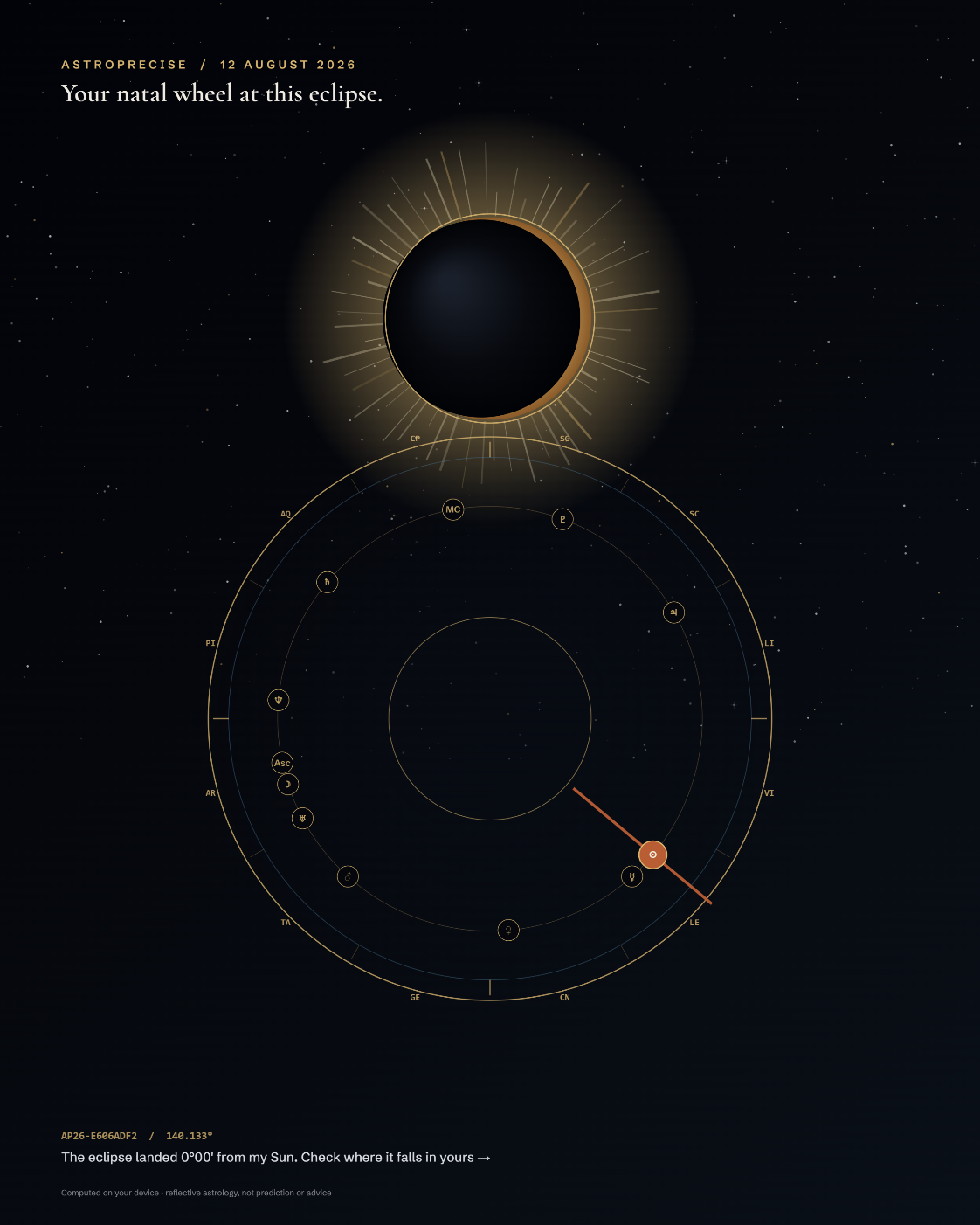
The free guide gets everyone ready. If the free calculator finds a direct eclipse contact, Your Eclipse Edition can add a five-beat reading and unique high-resolution artwork — computed instantly from your own chart.
 Personalised
eclipse chart
downloadable PNG
Your Eclipse Edition is offered only after a direct conjunction, opposition or square. It gives you a five-beat eclipse-contact reading and unique high-resolution artwork derived from the computed chart contact. Downloadable PNG with an honest print/save-as-PDF view. Instant and automated.
Every astronomical value is included only after calculation. Unknowns stay visible instead of being dressed up as certainty. Birth data never leaves your browser.
- Five-beat personalised eclipse-contact reading
- Unique high-resolution chart artwork
- Downloadable PNG
- Print / save-as-PDF view
- Instant and automated
Instant edition£7
Precise enough to trust. Personal enough to keep.
Continue: Live 3D eclipse instrument · NASA live coverage
Sources checked 11 August 2026: NASA eclipse overview · NASA GSFC calculations · Royal Observatory Greenwich · AAS eye safety.
Cover artwork is an artistic alignment study, not a ground-track map and not to scale. AstroPrecise · astroprecise.app